
TaskGroups — Organizing Large DAGs Visually
A Folder, Not a New Task Type
A DAG with 40 tasks and no structure is unreadable in the Graph View — one tangled mess of boxes and arrows. TaskGroups don't add any new execution behavior; they're purely a visual/organizational grouping that collapses related tasks into one box you can expand on demand.
The Problem
Picture a DAG that extracts from three sources and loads into two targets. Without any grouping, that's five tasks scattered flat across the Graph View, with no visual signal that "these three belong together" or "these two belong together." At 5 tasks it's mildly annoying. At 40, it's unreadable.
Grouping Tasks with TaskGroup
from airflow.decorators import dag, task
from airflow.utils.task_group import TaskGroup
from datetime import datetime


@dag(schedule=None, start_date=datetime(2024, 1, 1), catchup=False)
def multi_source_pipeline():

    @task()
    def start():
        print("Pipeline started")

    with TaskGroup(group_id="extract_sources") as extract_group:
        @task()
        def extract_api():
            return {"source": "api", "rows": 500}

        @task()
        def extract_db():
            return {"source": "db", "rows": 1200}

        @task()
        def extract_files():
            return {"source": "files", "rows": 80}

        extract_api()
        extract_db()
        extract_files()

    with TaskGroup(group_id="load_targets") as load_group:
        @task()
        def load_warehouse():
            print("Loaded into warehouse")

        @task()
        def load_cache():
            print("Loaded into cache")

        load_warehouse()
        load_cache()

    @task()
    def finish():
        print("Pipeline finished")

    # Dependencies wire to the TaskGroup itself, not to individual
    # tasks inside it - every task in extract_group finishes before
    # load_group's tasks can start.
    start() >> extract_group >> load_group >> finish()


multi_source_pipeline()
That's the exact DAG behind this real, successful run — both groups expanded, showing every task inside them:
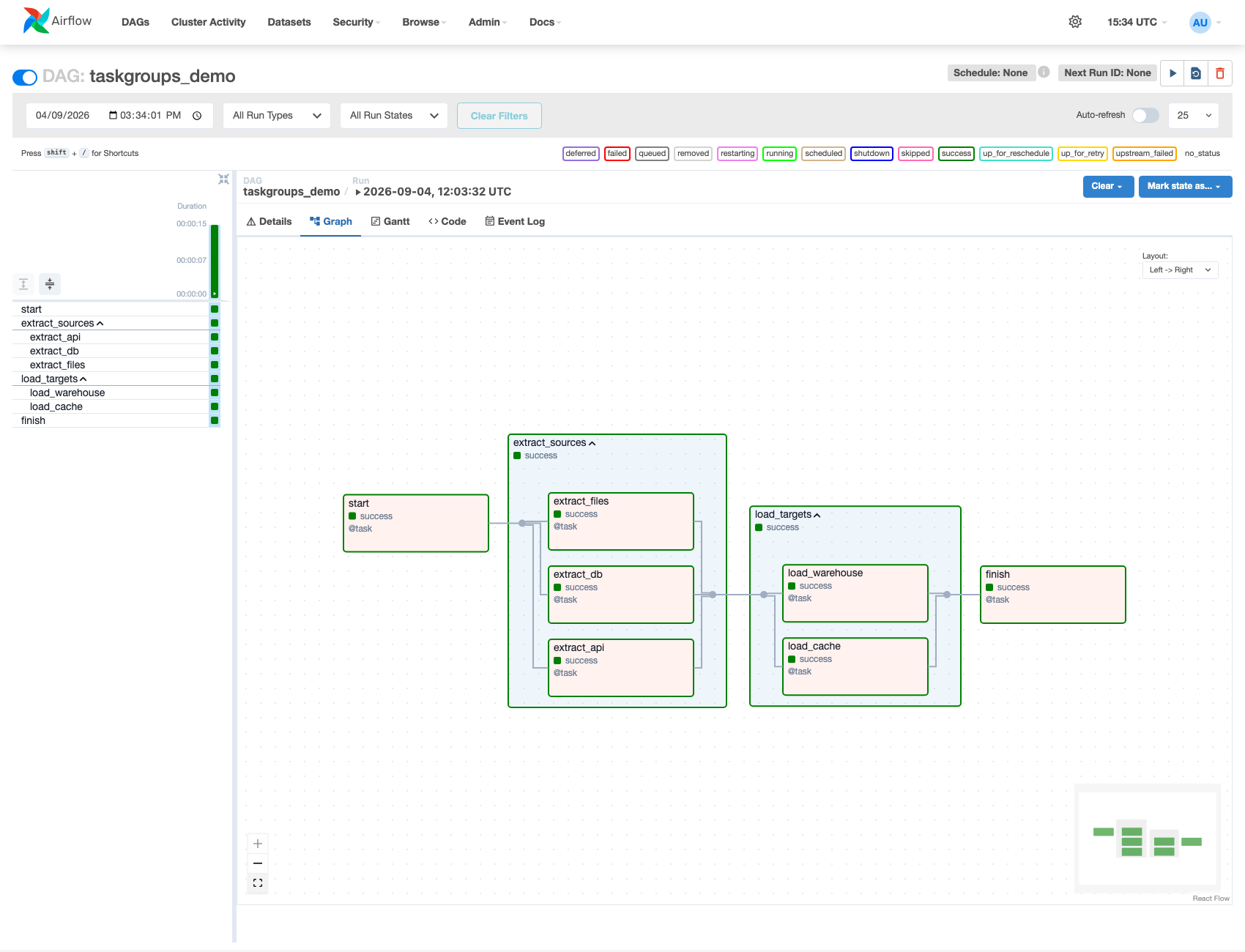 Figure — TaskGroups render as bordered boxes in the Graph View. Click the box to collapse it back down to a single node.
Collapsed, extract_sources and load_targets shrink to two boxes total instead of five — that's the entire point. On a real 40-task DAG organized into 6-8 groups, the Graph View goes from unreadable to skimmable in about thirty seconds of refactoring.
Task IDs Inside a Group
Airflow automatically prefixes task IDs with the group ID, using a .:
| What you wrote | Actual task_id |
|---|---|
extract_api inside TaskGroup(group_id="extract_sources") |
extract_sources.extract_api |
load_warehouse inside TaskGroup(group_id="load_targets") |
load_targets.load_warehouse |
This matters the moment you reference a task from outside its group — e.g., pulling an XCom: ti.xcom_pull(task_ids="extract_sources.extract_api"), not just "extract_api".
TaskGroups can nest inside other TaskGroups (
with TaskGroup("outer"): with TaskGroup("inner"): ...) for genuinely large DAGs. Two levels is usually the practical ceiling before it becomes as hard to navigate as no grouping at all.
TaskGroups vs Dependency Behavior
It's worth being explicit about what TaskGroups don't change:
| TaskGroup | SubDAG (deprecated, don't use) | |
|---|---|---|
| Adds a new task type | No — same tasks, same executor slots | Yes — spawned an entire nested DAG |
| Extra scheduling overhead | None | Significant (separate DAG run per SubDAG) |
| Purpose | Pure visual/organizational grouping | Was meant for reuse, mostly obsoleted by TaskGroups + Dynamic Task Mapping |
If you've seen older Airflow tutorials mention SubDAGs — TaskGroups are almost always the better, simpler replacement for what SubDAGs were trying to solve.