Building With AI — Meet the AI-DLC
Imagine you get a new teammate at work. This teammate can type code faster than anyone you've ever seen, knows almost every programming language, and never gets tired. Sounds amazing, right?
There's one catch: this teammate is a robot, and it takes instructions extremely literally. If you're vague, it doesn't stop and think "hmm, that's probably not what they meant" — it just builds something, very fast, and hands it back to you.
That teammate is what we mean by "building with AI." It isn't a magic wand that reads your mind — it's a very fast, very eager junior partner. And just like any new teammate, working well together needs a method, not just vibes. That method is what this lesson is about: the AI-DLC.
What Does "Building With AI" Actually Mean?
In the old days, if you wanted software, a person sat down and typed every single line of it. Slow, careful, one keystroke at a time.
Today, it works differently:
- A person describes what needs to be built and why.
- An AI agent (like Robo) writes a big chunk of the actual code.
- The person checks the work, corrects it, and guides the next step.
The person moves from "typist" to "director." That's a huge shift — and it's exactly where things can go wrong if you're not careful.
The Bad Way: "Just Build Me a Treehouse"
Let's say you tell Robo: "Build me a good treehouse." Nothing else. No plan.
You: Build me a good treehouse!
Robo: On it!
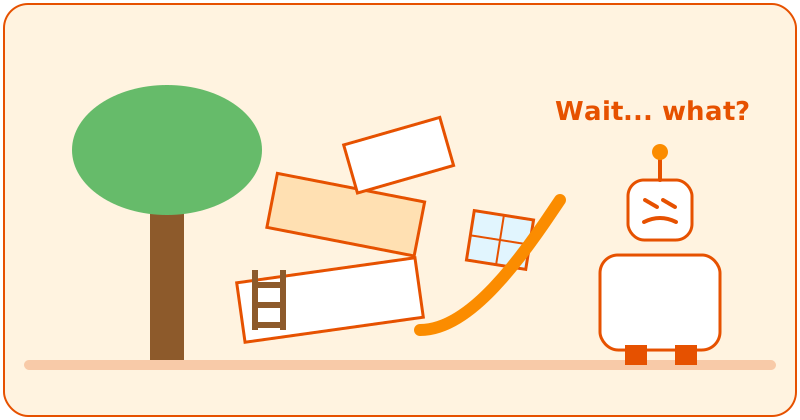
Robo did build something — fast — but it's not what you wanted, because you never said what you wanted: three mismatched floors, no ladder that reaches the ground, a slide going the wrong way, and a window with no wall under it. This is sometimes called "vibe coding": typing vague requests and hoping for the best. It feels quick at first, but you usually end up paying for it later, when you discover the mistakes only after the treehouse is already nailed together.
The Good Way: Plan First, Then Build
You: Here's a sketch. Two floors, a rope ladder on the east side, a window facing the garden, and it needs to hold at least 3 kids safely.
Robo: Got it. Let me confirm a few things first, then I'll build it exactly to this plan.
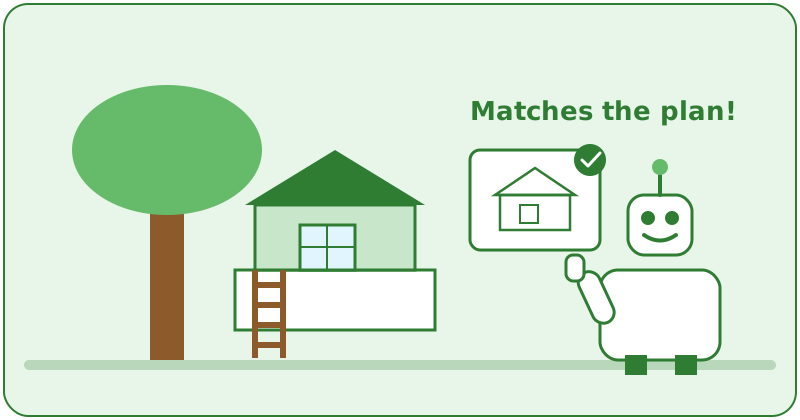
Same robot, same speed — but a completely different, much better result. The difference wasn't Robo's skill. It was having a shared plan before any hammering started.
Why We Need a Method, Not Just Vibes
A Development Life Cycle (DLC) is simply: a repeatable set of steps we follow every time we build something, so we don't forget important stuff and the outcome is reliably good — just like following a recipe instead of randomly throwing ingredients into a bowl.
- No recipe: sometimes the cake is great, sometimes it's a disaster, and you can never tell why.
- With a recipe: the cake turns out good almost every time, and if something goes wrong, you can check exactly which step was skipped.
The AI-DLC is that recipe, adapted for a world where an AI agent does a lot of the "cooking." It gives you and your AI teammate a shared, repeatable way of working together so that speed doesn't come at the cost of quality.
Two Ways People Usually Use AI (and Why AI-DLC Finds the Middle)
When teams started building with AI, most of them landed in one of two extremes:
Too hands-off. You ask the AI to build the whole thing, walk away, and come back later to a finished app. It's fast — but if you never really followed what it built, you can't confidently explain how it works, fix it when something breaks, or trust it in front of real users.
Too hands-on. You only ever ask the AI for tiny, narrow favors — "write this one function," "fix this one line" — and keep every single decision to yourself. It's safe, but painfully slow, because you're barely using how fast the AI actually is.
AI-DLC sits in the middle: you and the AI agree on a clear, shared plan up front (Inception), the AI does the heavy lifting of building it in clearly checkable pieces (Construction), and you stay involved exactly where it matters — reviewing the plan, reviewing each piece, deciding what happens next — instead of either disappearing entirely or micromanaging every keystroke.
Introducing the AI-DLC
AI-DLC stands for AI-Driven Development Life Cycle. It organizes all the work into three big phases:
flowchart LR
    I["Inception\nPlan it"] --> C["Construction\nBuild it"]
    C --> O["Operations\nLive with it"]
    O -.-> I

    classDef phase fill:#e1bee7,stroke:#7b1fa2,stroke-width:2px;
    class I,C,O phase;
The dotted arrow looping back from Operations to Inception is the important part: it stands for everything you learn once real people start using the thing you built. AI-DLC isn't a straight line you walk once — it's a cycle. Every round through Operations teaches you something new, and that new learning kicks off the next small Inception.
| Phase | Kid-Friendly Analogy | In One Line |
|---|---|---|
| Inception | Planning the treehouse | Turn a rough idea into a clear, agreed-upon plan |
| Construction | Building the treehouse | Turn the plan into real, working, tested software |
| Operations | Living in and caring for the treehouse | Use it for real, watch it, fix it, learn from it |
Meet the Three Phases
1. Inception — Planning the Treehouse
Before anyone picks up a hammer, you and Robo sit down and figure out: What is this treehouse actually for? Who's going to use it? How many kids does it need to hold? Where's the ladder going? This conversation gets written down as a plan — a document everyone agrees on before anything gets built. Mistakes caught here are cheap: it's just eraser marks on paper.
2. Construction — Building the Treehouse
Now the plan becomes real. But you don't build the whole treehouse in one giant, chaotic rush — you build it piece by piece: floor first, then walls, then the ladder, checking each piece is solid before moving to the next. In AI-DLC, the plan gets broken down into small units of work — each one a short, focused round of building (often just a few hours) where you and Robo tackle one clear piece, test it, and confirm it's solid before starting the next one.
3. Operations — Living In and Caring For the Treehouse
The treehouse is built and kids are climbing up and playing in it. Now you keep an eye on it: is a plank getting loose? Did someone ask for a flag on top? Is the ladder holding up in the rain? Operations is where you watch the real thing being used, fix what breaks, and collect new ideas — which flow right back into the next Inception.
How This Is Different From Old-School Software Development
You may have heard of things like "Agile" or "two-week sprints." AI-DLC follows the same spirit — plan, build, review, repeat — but it's built around the fact that an AI agent can type and test code dramatically faster than a human alone.
| Traditional Development | AI-DLC | |
|---|---|---|
| Who writes most of the code | A human, line by line | An AI agent, guided by a human |
| Typical cycle length | Days to weeks (a "sprint") | Hours to a day (one unit of work) |
| Human's main job | Typing the code | Planning, reviewing, and steering |
| Plan document | Sometimes skipped under time pressure | Always written first — it's cheap and fast to produce |
Because typing code got so much faster, the planning and reviewing parts became the most valuable use of a human's time — which is exactly why Inception is treated as such a serious, first-class step, not a box to rush through.
A Quick Note
This lesson is based on a real methodology called AI-DLC (AI-Driven Development Life Cycle). It isn't tied to one specific product — the same three phases work whether you're pairing with Kiro, Claude Code, Cursor, or any other AI coding agent; it's a way of working, not a piece of software. Robo, Ms. Sharma, and the treehouse are just our way of making it easy to picture.
What's Next
In the next lesson, we'll stop talking in the abstract and pick a real, easy-to-understand problem: helping a school librarian, Ms. Sharma, stop losing track of borrowed books. We'll walk through the entire AI-DLC on this one problem — starting with the very first conversation with Robo in the Inception phase.
Continue to: Inception Phase — Planning the Idea