Deployment Techniques & CI/CD
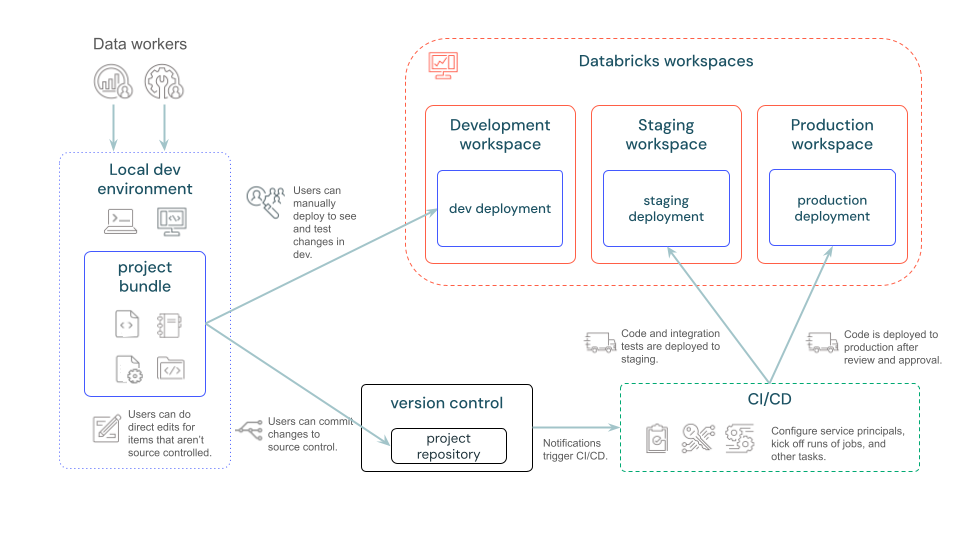
Deploying data and AI projects reliably on Databricks requires adopting modern software engineering practices such as continuous integration and continuous delivery (CI/CD), version control, and infrastructure as code.
Core Deployment Strategies
-
Databricks Asset Bundles (Recommended) Bundles represent the latest and most robust way to deploy projects. They allow you to define jobs, pipelines, and ML resources as code using YAML, providing a unified deployment artifact that can be pushed across dev, staging, and prod environments.
-
Databricks Git Folders (formerly Repos) Git folders provide Git integration directly within the Databricks workspace. Developers can clone repositories, author code, commit, and push changes back to providers like GitHub, GitLab, or Azure DevOps.
-
Terraform Integration For broader infrastructure management, the Databricks Terraform provider allows you to provision workspaces, clusters, and users alongside your deployment pipelines.
Environment Management
Best practices dictate isolating your environments to ensure stability and security:
- Development Environment: Where data engineers and data scientists author code, usually tied to individual Git branches.
- Staging/Testing Environment: An automated environment where tests (unit tests, integration tests) run against a subset of production data.
- Production Environment: A highly restricted environment where jobs are orchestrated on a schedule, with read-only access for most users.