What is AWS Glue? — And Why It Matters for Data Engineers
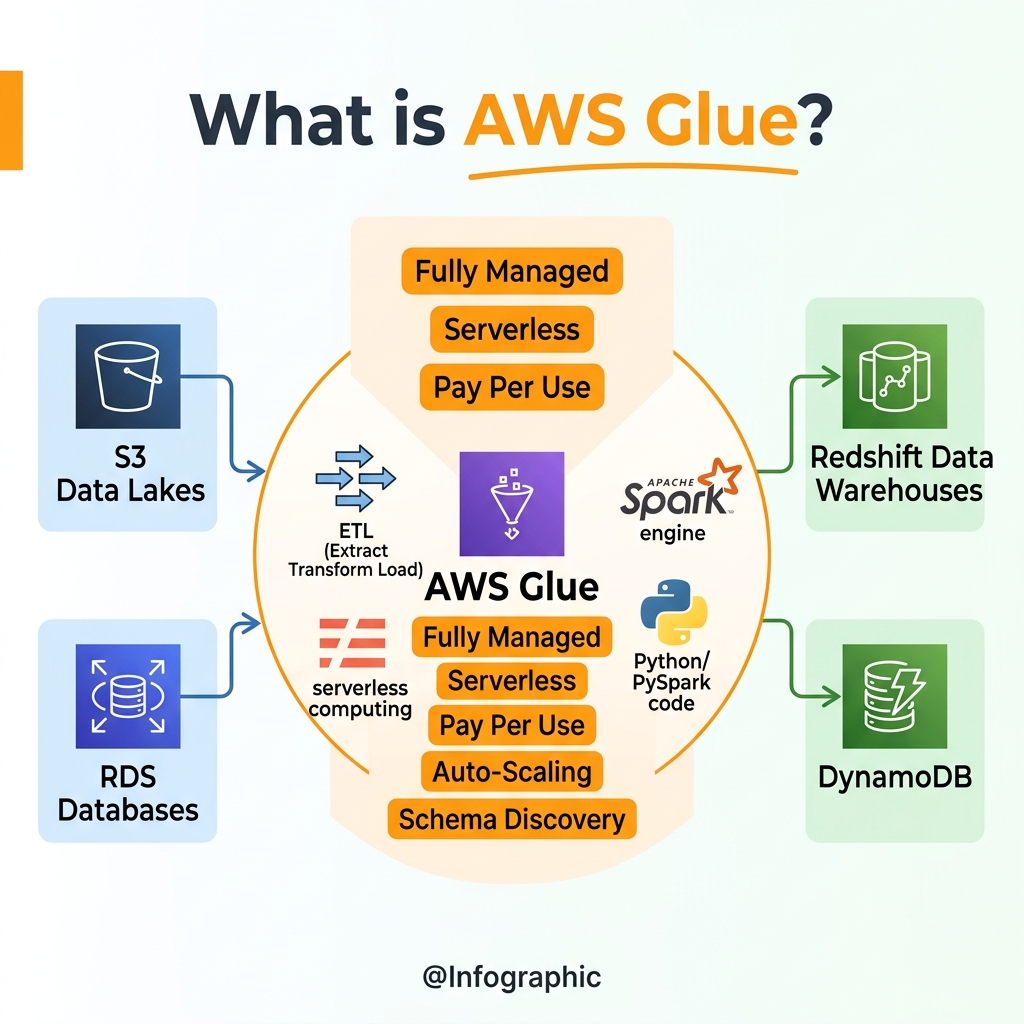
AWS Glue is a fully managed, serverless ETL (Extract, Transform, Load) service provided by Amazon Web Services. It is purpose-built to help data engineers discover, prepare, move, and integrate data from multiple sources for analytics, machine learning, and application development.
The Problem Glue Solves
Before AWS Glue, building a production ETL pipeline required:
- Provisioning and Managing Servers — You needed to spin up EC2 instances, install Apache Spark or Hadoop, manage OS patches, and handle cluster autoscaling yourself.
- Writing Custom Schema Discovery — For every new data source (CSV, Parquet, JSON, JDBC databases), you had to write and maintain schema parsers manually.
- Building Job Orchestration — You needed external tools (Airflow, Oozie, cron jobs) to schedule, trigger, and retry failed ETL pipelines.
- Managing Metadata Repositories — Maintaining a central catalog of all your data assets across S3, RDS, Redshift, and DynamoDB required custom-built or third-party metastore solutions (like a standalone Apache Hive Metastore).
AWS Glue eliminates all of this infrastructure burden by packaging it into a single, integrated, pay-per-use managed service.
Core Value Propositions
| Feature | What it Means for You |
|---|---|
| Fully Managed | No servers to provision, patch, or maintain. AWS handles the entire infrastructure lifecycle. |
| Serverless | You don't manage clusters. Glue automatically allocates and de-allocates compute resources as needed. |
| Pay Per Use | You are billed only for the compute time consumed during ETL job execution (measured in DPU-hours). No idle cluster costs. |
| Auto-Scaling | Glue dynamically scales the number of worker nodes based on data volume and processing complexity. |
| Schema Discovery | Glue Crawlers automatically scan your data stores and infer schemas, populating a centralized Data Catalog without manual effort. |
| Apache Spark Engine | Under the hood, Glue ETL runs on a fully managed Apache Spark environment, giving you the power of distributed computing. |
| Native Python/PySpark | Write your ETL scripts in Python (PySpark) or Scala — no need to learn proprietary query languages. |
Key Components at a Glance
AWS Glue is not a single tool — it's a suite of integrated components:
1. AWS Glue Data Catalog
A centralized, persistent metadata repository. It stores table definitions, schema information, partition metadata, and connection properties for all your data assets. Think of it as a managed Apache Hive Metastore that works across your entire AWS ecosystem.
2. AWS Glue Crawlers
Automated metadata scanners. A Crawler connects to your data store (S3, JDBC, DynamoDB), samples the data, infers its schema (column names, data types, partitions), and registers the metadata in the Data Catalog.
3. AWS Glue ETL Jobs
The actual processing workhorses. An ETL Job is a user-defined script (Python or Scala) or a visually designed pipeline using AWS Glue Studio that reads from source tables, applies transformations, and writes to target data stores. Under the hood, each job runs on a managed Apache Spark cluster.
4. AWS Glue Triggers & Workflows
Job orchestration tools. Triggers can start ETL Jobs based on schedules (cron-like), events (e.g., an S3 file arrival via EventBridge), or the completion of other jobs. Workflows chain multiple crawlers, jobs, and triggers into a single visual pipeline.
5. AWS Glue Job Bookmarks
State management for incremental loads. Bookmarks track which data has already been processed in previous runs, so subsequent runs only process new or changed data, avoiding expensive full-table re-scans.
Why is AWS Glue Useful? — Real-World Use Cases
Use Case 1: Building a Data Lake on S3
You have raw data landing in S3 in various formats (CSV, JSON, Parquet). Glue Crawlers automatically discover and catalog this data. Glue ETL Jobs then clean, transform, and write it back to S3 in an optimized columnar format (Parquet/ORC) for downstream analytics by Athena or Redshift Spectrum.
Raw Data (CSV/JSON in S3)
        │
        ▼
  ┌─────────────┐
  │ Glue Crawler │  ──▶  Discovers schema, registers in Data Catalog
  └─────────────┘
        │
        ▼
  ┌─────────────┐
  │ Glue ETL Job│  ──▶  Cleans, deduplicates, converts to Parquet
  └─────────────┘
        │
        ▼
Optimized Parquet on S3  ──▶  Queried by Athena / Redshift Spectrum
Use Case 2: Database Migration / Replication
You need to migrate data from an on-premises MySQL database to Amazon Redshift. Glue can connect to your MySQL instance via JDBC, extract the data, transform column types and business logic, and load it directly into Redshift — all without managing any intermediate infrastructure.
Use Case 3: Real-Time CDC (Change Data Capture)
With Glue Streaming ETL Jobs (using Spark Structured Streaming), you can continuously process change events from Amazon Kinesis Data Streams or Apache Kafka, transform them in near real-time, and load them into your data lake or warehouse.
Use Case 4: Machine Learning Feature Engineering
Data scientists often need clean, well-structured datasets. Glue ETL Jobs can be used to preprocess raw data, engineer features (aggregations, one-hot encoding, normalization), and store them in S3 for consumption by Amazon SageMaker.
AWS Glue vs. Alternatives — When to Use What?
| Criteria | AWS Glue | Amazon EMR | AWS Data Pipeline | Apache Airflow (MWAA) |
|---|---|---|---|---|
| Management | Fully managed, serverless | Managed clusters (you configure sizing) | Managed orchestration | Managed Airflow (you define DAGs) |
| Engine | Apache Spark (managed) | Spark, Hive, Presto, Flink, etc. | Custom activities | Any (via operators) |
| Best For | ETL, cataloging, serverless pipelines | Complex/custom big data workloads | Legacy pipeline orchestration | Advanced orchestration with custom logic |
| Cost Model | Pay per DPU-hour consumed | Pay per EC2 instance hour | Pay per activity + instances | Pay per environment + workers |
| Schema Discovery | Built-in (Crawlers + Data Catalog) | Manual or external | Manual | Manual |
| Learning Curve | Low (console + PySpark) | Medium-High | Medium | Medium (Python DAGs) |
Rule of Thumb: - Use AWS Glue when you want a zero-infrastructure, schema-aware ETL service with built-in cataloging. - Use Amazon EMR when you need fine-grained control over your Spark/Hadoop cluster or need to run non-Spark engines like Presto or Flink. - Use Apache Airflow (MWAA) when you need complex DAG-based orchestration beyond what Glue Workflows can offer.
Pricing Model
AWS Glue charges are based on DPU (Data Processing Units):
| Component | Pricing Unit |
|---|---|
| Glue ETL Job | Per DPU-hour (1 DPU = 4 vCPUs + 16 GB RAM). Billed per second with a 1-minute minimum. |
| Glue Crawler | Per DPU-hour consumed during crawl runs. |
| Data Catalog | First 1 million objects stored free. $1.00 per 100,000 objects/month after. |
| Development Endpoint | Per DPU-hour while active (use interactive sessions instead for cost savings). |
Cost Optimization Tip: Use Glue Auto Scaling (available in Glue 3.0+) to let AWS dynamically right-size the number of workers, so you never over-provision.
Summary
AWS Glue is the backbone of serverless data integration on AWS. It combines automated schema discovery, managed Apache Spark ETL, centralized metadata cataloging, and built-in orchestration into a single service — enabling data engineers to focus on business logic rather than infrastructure management.
In the next sections, we will deep-dive into the Glue Architecture and learn how to create and run your first Glue ETL Job.